Pension Auto Enrolment UK: Employer Responsibilities, Contributions and Compliance
What is pension auto enrolment?
Pension auto enrolment is a legal requirement that requires UK organisations to automatically enrol qualifying employees in a company pension scheme while also making contributions to their retirement funds.
Simple enough on paper. The reality is a little different.
If you employ people in the UK, pension auto enrolment isn’t something you can afford to put on the back burner.
Every payday brings a new set of moving parts. A new starter joins. Someone receives a pay rise. Another employee celebrates their 22nd birthday. Overnight, pension eligibility can change.
The rules themselves are not particularly difficult. Keeping pace with them is where many employers come unstuck. That is why pension auto enrolment is no longer just an HR responsibility. It has become a payroll responsibility, too.
Whether you’re employing five people or five hundred, having the right processes in place makes the difference between staying ahead and constantly catching up.
Who needs to be automatically enroled?
An employee generally qualifies for auto enrolment if they:
- Are aged between 22 and State Pension age
- Earn above the current earnings threshold for auto enrolment.
- Ordinarily work in the UK
Employees who do not meet these criteria may still have the right to opt into a pension scheme or join one, depending on their circumstances.
Before you know it, an employee’s eligibility can change. It needs ongoing attention to make sure you’re always meeting your compliance needs.
A birthday, a pay rise, or even a change in working hours can move someone from one category to other.
That is why pension assessments should happen every pay cycle, not just when someone joins the business.
Why is pension auto enrolment important?
For employees, it is a method of saving money for retirement with a portion of their salary and contributions from their employer.
For employers, it is a legal obligation that ensures proper management of employees and their financial well-being.
It also helps build trust.
When it comes to workplace pensions, consistency can be a bigger concern than compliance. Getting those contributions right helps keep employees’ retirement accounts on track, while frequent errors can lead to frustration and extra administrative work.
What are an employer’s responsibilities?
Auto enrolment involves much more than enroling employees. Every auto enrolment task builds on the one before it.
Employers are responsible for:
- Assessing every employee’s eligibility
- Automatically enroling eligible workers
- Calculating pension contributions correctly
- Paying employer contributions on time
- Communicating with employees
- Managing opt-ins and opt-outs
- Keeping accurate payroll and pension records
- Completing the required declarations with The Pensions Regulator
Each step matters because they all feed into the next. Miss one piece and the whole process becomes harder to manage.
Why do payroll and pension data need to work together?
Most pension mistakes are not caused by contribution calculations.
They happen much earlier.
An employee’s salary changes.
HR updates the record.
Payroll doesn’t receive the update.
Pension contributions continue using outdated information.
No one notices until months later.
That is why pension auto enrolment is no longer just about understanding the rules. It is about making sure every part of the payroll process is working from the same information.
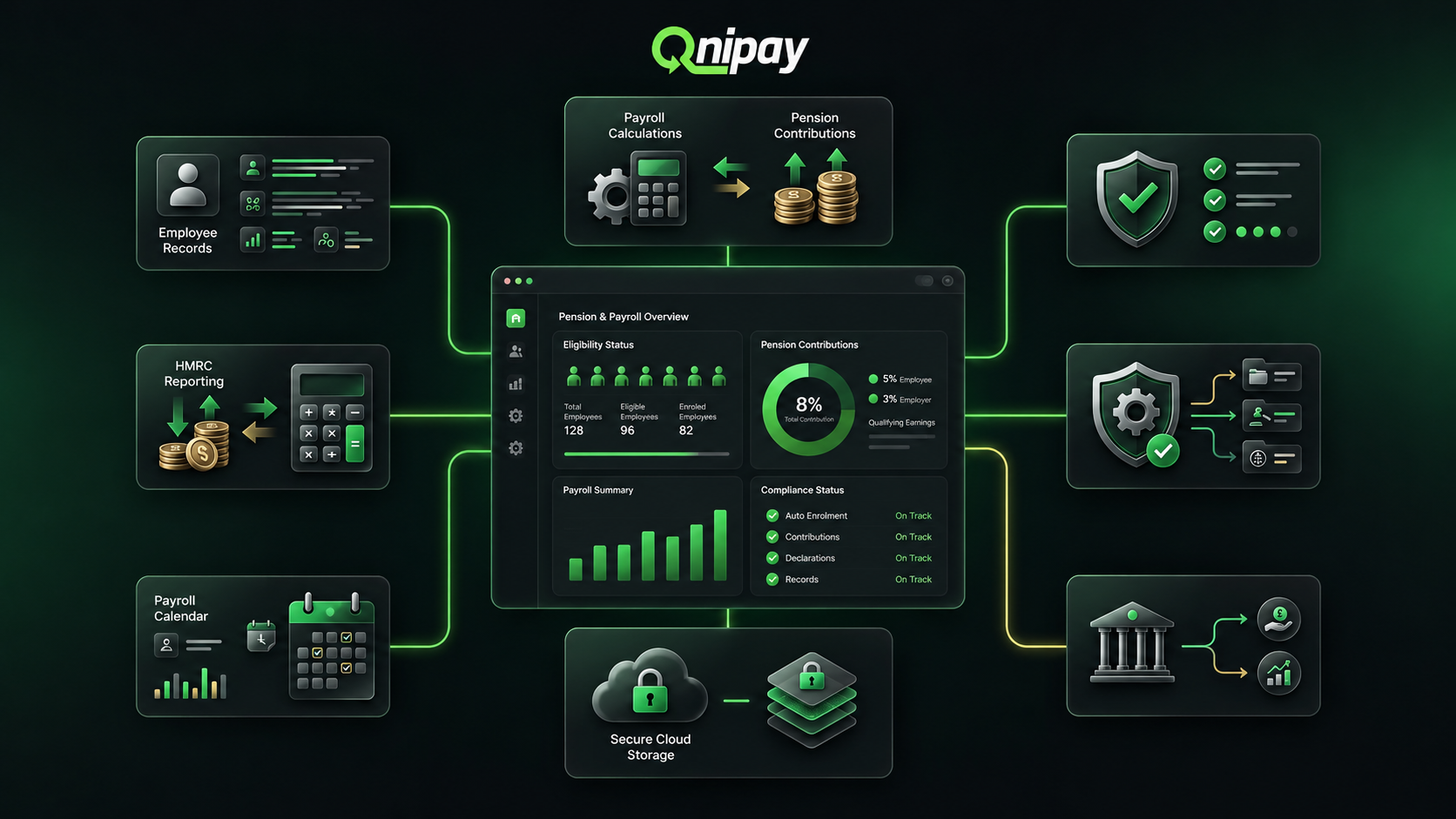
This is where integrated payroll platforms like Qnipay make a real difference. When payroll, employee records, and pension administration are connected, there is less manual work, fewer opportunities for error, and greater confidence that every pay run starts with accurate data.
How often should employers assess eligibility?
Every pay cycle.
This is one of the most consistently overlooked aspects of auto enrolment. Someone who was not eligible last month might be this month if they crossed the threshold or turned 22.
Waiting until the end of the year is like checking the weather after you’ve already been caught in the rain. By then, you’re reacting instead of preparing.
The regular assessments ensure that employers remain compliant with the law while at the same time allowing the employees to enjoy the retirement benefit, they are entitled to.
How much do employers need to contribute?
Under current UK auto enrolment rules, the minimum total pension contribution is 8% of qualifying earnings. Typically:
- 5% comes from the employee
- 3% comes from the employer
Whatever contribution level you choose, discipline matters. Even a small mistake can spiral into a much bigger payroll issue if it goes unrecognized for multiple pay periods.
What happens if an employee opts out?
Employees have the legal right to opt out after being enroled.
If they choose to opt out within the official opt-out period, any contributions that have already been deducted are generally refunded.
The key point for employers is clear.
Employees can opt to leave the scheme, but employers must never persuade or inspire them to do so. The decision must always remain with the employee.
What is pension re-enrolment?
Every three years, you must re-enrol employees who opted out of the workplace pension or stopped contributing to it. This means that these workers will have their contributions deducted from their wages again, if they are entitled to join a workplace pension.
Re-enrolment is easy to overlook because it only happens every three years. But it plays an important role. People’s earnings change, careers progress, and financial priorities evolve. Someone who opted out a few years ago may be in a very different position today. Re-enrolment gives eligible employees another opportunity to start saving without having to begin the process themselves.
Common pension auto enrolment mistakes employers make
Most compliance problems do not happen because employers ignore the rules. They happen because small administrative gaps quietly grow over time.
Some of the most common mistakes include:
- Missing changes in employee eligibility
- Incorrect pension calculations
- Late pension submissions
- Incomplete employee communications
- Poor payroll record-keeping
- Relying on manual spreadsheets long after the business has outgrown them
Small cracks rarely stay small. Left unattended, they spread into payroll corrections, compliance issues, and unnecessary administration.
How payroll software simplifies pension auto enrolment?
Auto enrolment works best when payroll, employee records, and pension data move together.
Instead of manually reviewing every employee during each pay run, modern payroll software can automatically assess eligibility, calculate pension contributions, generate pension files, and maintain the records needed for compliance.
This is where connected payroll platforms such as Qnipay make a real difference. By bringing payroll, HR, pension administration, and employee records into one place, employers can spend less time chasing information and more time keeping payroll accurate.
The goal is not simply to automate payroll.
It is to build a process that remains dependable as your business grows.
Best practices for staying compliant
If you want pension auto enrolment to become part of your routine rather than a recurring source of stress, a few habits make all the difference.
- Review employee eligibility every pay period.
- Keep employee records accurate and up to date.
- Communicate clearly whenever pension status changes.
- Carry out re-enrolment on time.
- Use payroll software that supports pension administration instead of relying on manual processes.
Good compliance is rarely about working harder.
More often, it comes from building processes that work consistently in the background.
Pension Auto Enrolment Checklist
Before your next payroll run, ask yourself:
✓ Have all new starters been assessed?
✓ Have any employees recently become eligible?
✓ Are pension contributions being calculated correctly?
✓ Have opt-outs been processed?
✓ Are payroll records up to date?
✓ Are communications ready for affected employees?
FAQs about Pension Auto Enrolment
1. Is pension auto enrolment mandatory in the UK?
Yes. UK employers must automatically enrol eligible employees into a workplace pension scheme and meet their ongoing legal responsibilities.
2.Does every employee qualify for auto enrolment?
No. Eligibility depends on age, earnings, and whether the employee ordinarily works in the UK.
3.Can employees opt out of workplace pensions?
Yes. Employees have the legal right to opt out after being enroled, provided they follow the official opt-out process.
4.Can payroll software automate pension auto enrolment?
Yes. Modern payroll software can automatically assess employee eligibility, calculate pension contributions, generate pension files, and maintain the records needed to support compliance.
5.What happens if an employer misses their auto enrolment duties?
Failure to meet pension auto enrolment duties can lead to enforcement action and financial penalties from The Pensions Regulator.
The bottom line
Pension auto enrolment is not becoming more complicated. Expectations are simply becoming higher.
Employees expect accurate contributions. Regulators expect timely reporting. Employers expect payroll to keep everything moving without constant intervention.
That is why more businesses are moving towards connected payroll platforms like Qnipay. Not because pension auto enrolment is difficult, but because keeping every moving part aligned becomes much easier when payroll, HR, and compliance work from the same source of truth.
When the right systems are in place, pension auto enrolment stops feeling like another compliance task and becomes simply another part of a payroll process that works.